When your ’lectric bill is giving you a lickin’…
The savings problemWhen the bill is giving you a lickin’
Cost Savings
Solar Chicken is funny because the electric bill is not. Cost savings start with the real bill: how much power you buy, when you buy it, what the utility charges, and how solar plus batteries can change the pattern.
Savings basics
Solar savings begin by buying less expensive utility power.
A solar system can reduce the amount of electricity a home or business buys from the utility. A battery system can improve the timing of that energy by storing solar power for later use, especially when utility rates are high or backup power matters.
The exact savings depend on the customer’s bill, rate schedule, roof, shade, system size, battery operation, utility rules, installation cost, financing, incentives, and future loads.
- Solar panels produce power during daylight hours.
- Batteries can store solar energy for expensive periods.
- Backup power has value beyond monthly bill savings.
- Restaurant and business loads may create stronger savings opportunities.
- Good savings estimates require real bills and real design review.
Free money from the state can’t overlook it,
Solar systems are ready, so it’s time to book it!
Just call for Solar Chicken!
Start the reviewThe Solar Chicken Song stays here because savings are the serious point inside the joke.
What creates savings
Four levers matter most.
Solar cost savings are not one magic number. They come from a combination of production, timing, avoided costs, backup value, and the property’s actual energy behavior.
Production
Solar panels make electricity from roof, canopy, or ground space that may otherwise sit unused.
Self-Use
Energy used directly by the home or business can reduce power purchased from the utility.
Battery Timing
Batteries can shift solar power into high-cost hours and improve the value of self-generated energy.
Resilience
Backup power can protect food, communication, business continuity, comfort, and safety during outages.
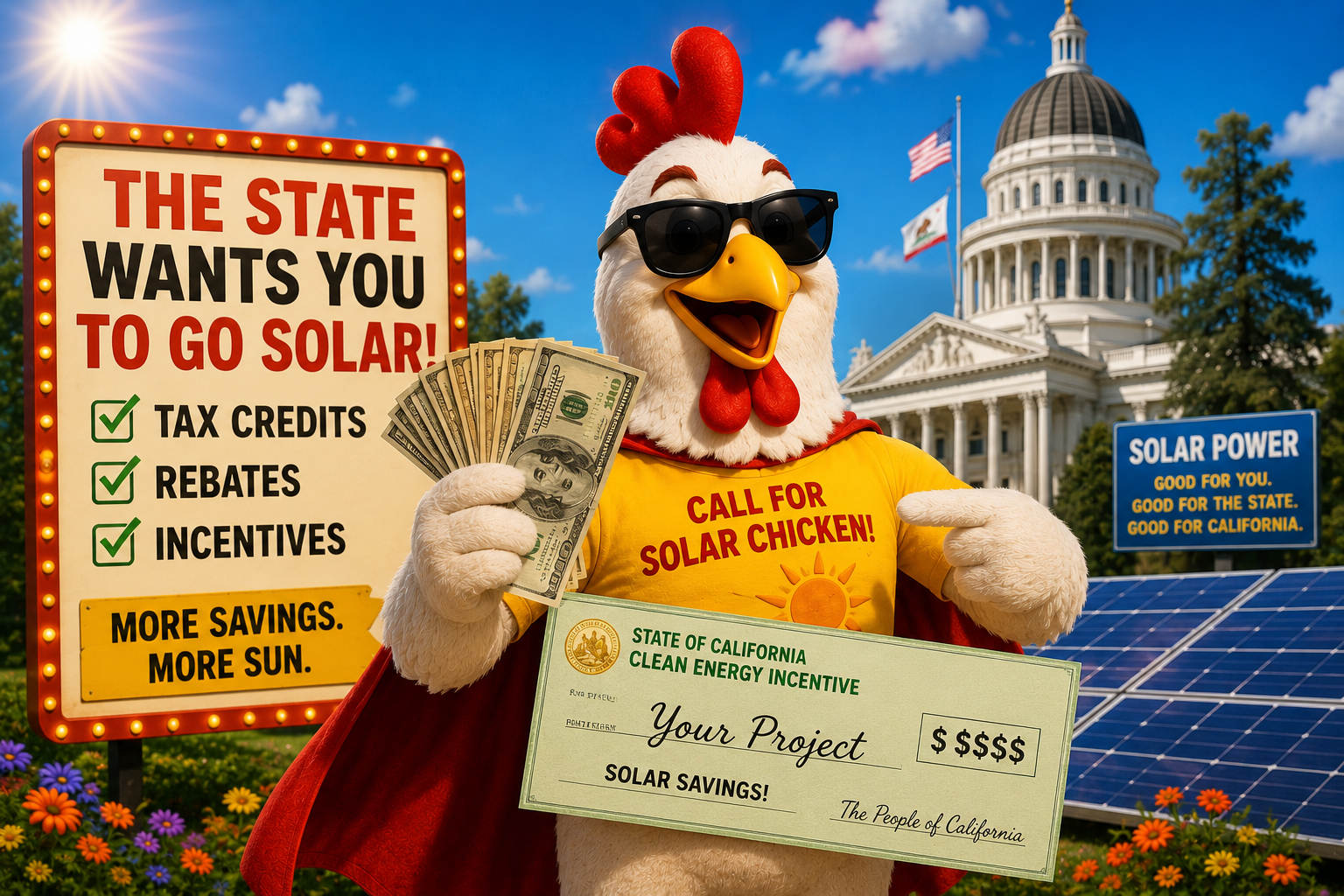
Incentives and programs
Incentives can improve the numbers, but the bill still drives the case.
Incentives, tax credits, rebates, depreciation, grants, and local programs can change project economics. The available programs depend on customer type, location, ownership structure, tax situation, utility rules, and current program availability.
Solar Chicken’s lyric says it directly: do not overlook the money. But incentives should support a real project, not cover up a weak design.
- Homeowners and businesses may qualify for different programs.
- Restaurants and commercial sites may have different tax and financing considerations.
- Battery incentives and export rules can change the value of storage.
- Program availability should be verified before relying on it.
Battery economics
Batteries add savings, backup, and control.
Batteries may help reduce grid purchases during expensive hours, increase use of on-site solar, and provide backup during outages. Their value depends on rates, export values, outage concerns, critical loads, and battery size.
In many modern solar projects, batteries are not just an add-on. They are part of the strategy: make power, store power, use power when it matters.
- Use more of your own solar energy.
- Shift energy into high-cost hours.
- Protect refrigerators, internet, lights, pumps, and key loads.
- Improve resilience during utility outages.
- Plan battery size around real loads and real goals.
Solar Chicken translation
Savings are not only about making power. They are about using the power at the right time.
“The cheapest power is the power you do not have to buy at the worst possible time.”
Solar Chicken savings rule
Savings review checklist
What ABC Solar needs to see.
A responsible savings conversation begins with real documents and real site information. Anything else is guesswork.
Electric Bills
Twelve months of bills help show usage, rates, seasonal changes, and actual cost history.
Rate Schedule
Time-of-use periods, demand charges, export values, and fixed charges affect savings.
Roof or Site
Available space, shade, orientation, roof condition, and equipment placement affect production.
Battery Goals
Peak savings, backup protection, self-use, and resilience goals shape the storage design.
Future Loads
EV charging, heat pumps, electric cooking, expansion, and new equipment affect the long-term plan.
Incentive Review
Tax credits, rebates, grants, and programs should be verified before they are included in the economics.
Keep the anthem attached
The savings page is the song’s business case.
The Solar Chicken Song works because it begins with the customer’s pain and ends with action. Cost savings are where that action becomes measurable.
When you find your sun is steady,
When your roof is new and ready,
When your ’lectric bill is giving you a lickin’…
Free money from the state can’t overlook it,
Solar systems are ready, so it’s time to book it!
Call for Solar Chicken!
Call for Solar Chicken dot com!
Do not promise savings without:
- Actual electric bills.
- Actual rate schedule.
- Actual roof or site review.
- Battery and backup goals.
- Utility and interconnection rules.
- Current incentive confirmation.
Next pages
From cost savings to system design.
Savings connect directly to electric bills, batteries, homes, restaurants, and the practical review process.
Electric Bill
Understand the problem before estimating the savings.
Bill page →Battery Backup
Store solar energy for timing, backup, and resilience.
Battery page →Solar for Homes
Review roof, bill, battery goals, and future household loads.
Home solar →Restaurants
Food businesses may have strong savings and resilience reasons to review solar.
Restaurant solar →How It Works
Learn how panels, batteries, inverters, loads, and monitoring work together.
Learn →Call ABC Solar
Ask for a practical savings review based on your actual bill and site.
Contact →ABC Solar Incorporated
When the bill hurts, review the numbers.
SolarChicken.com uses humor and song to make solar memorable. ABC Solar Incorporated provides solar power systems, battery backup systems, and practical energy design for homes and businesses.
California Contractor License CCL#914346.
Call when:
- Your electric bill is too high.
- You want solar savings reviewed from actual bills.
- You want battery storage for timing or backup.
- You own a home, restaurant, or business with serious loads.
- You want a practical ABC Solar project review.